
Business internet comes in two broad kinds, and the difference between them is one of the most misunderstood in the market. Providers sell shared broadband and dedicated circuits, and the language around both is full of words that sound like promises and are not.
Understanding what each actually provides, and what a service level agreement does and does not commit, lets you decide whether a more expensive option is worth buying.
Read this if a salesperson has offered a ‘dedicated’ circuit and an SLA and you cannot tell what you would be paying for. You can skip it if you already run servers or voice traffic that need a guaranteed circuit and your provider has explained the exclusions.
Shared and dedicated
Shared service, usually called business broadband, runs over infrastructure that many customers use at once. The capacity of the shared segment is divided among them, and your speed at any moment depends on what the others are doing. Providers rely on the fact that not everyone uses the maximum at the same time, a practice called oversubscription or contention. It works well most of the time, and it is why prices are low.
Dedicated service, often called dedicated internet access, provides a circuit reserved for your use. The bandwidth you buy is yours, not shared with the neighbours, and speed is consistent. It is typically symmetrical, comes with a service level agreement, and receives priority treatment when something breaks. It also costs considerably more.
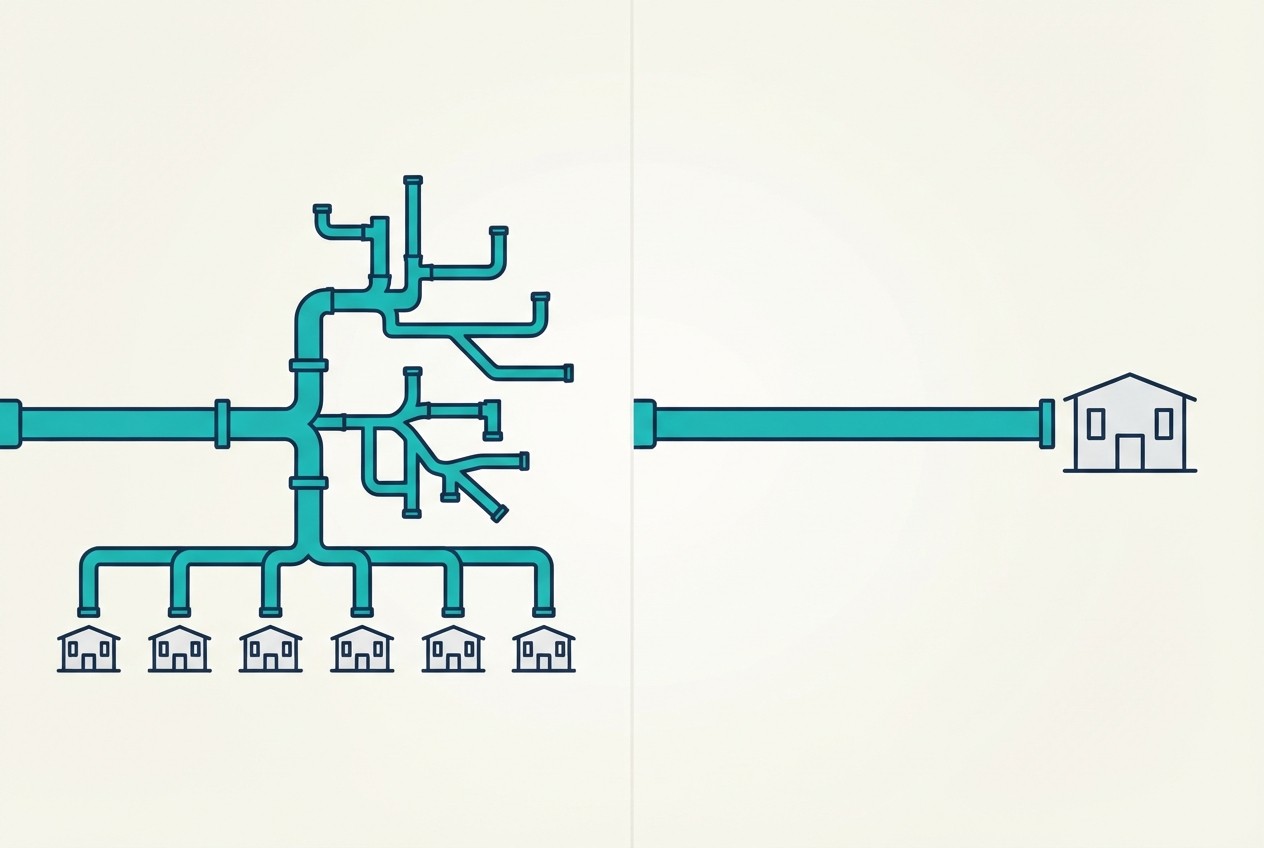
The distinction is blurrier than it sounds, because the word “dedicated” is used loosely. Some offers described as dedicated reserve capacity only on the last stretch to your building, and the provider’s core network remains shared. Ask exactly what is dedicated, to which point, and what guarantees apply beyond it.
What a service level agreement is
A service level agreement, or SLA, is the part of the contract that states what the provider commits to deliver and what happens if it does not. People imagine it as a guarantee that the service will work. It is closer to a price list for failure.
A typical SLA covers several measures:
- Availability. The percentage of time the service is up, usually measured monthly.
- Time to repair. How quickly the provider commits to restoring service after a fault is reported. This is often the most valuable commitment, and the most carefully worded.
- Latency. The delay in sending data across the provider’s network, to a defined point.
- Packet loss. The share of data that fails to arrive.
- Jitter. Variation in delay, which matters for voice and video.
- Remedy. What you receive if the provider misses a target, usually a credit on your bill.
Reading the availability number
Availability is quoted as a percentage, and the differences between figures look trivial and are not. Over a thirty-day month, which has about 43,200 minutes, the allowed downtime at each level works out roughly as follows:
| Availability commitment | Downtime allowed per month, roughly |
|---|---|
| 99 percent | About 7 hours |
| 99.9 percent | About 43 minutes |
| 99.99 percent | About 4 minutes |
A commitment of 99 percent still permits an entire working day of outage over a quarter, and the SLA is met. When you compare offers, convert the percentages into minutes, and ask whether that is acceptable for your business.
What an SLA usually does not promise
Read the exclusions with the same attention as the headline figures. SLAs routinely carve out the circumstances in which the provider owes nothing.
- Scheduled maintenance. Planned work, often with notice, does not count as downtime.
- Problems on your side. Faults in your equipment, your wiring or your network, or anything caused by you.
- Events outside the provider’s control. Often described as force majeure, covering severe weather, third-party cable cuts and similar.
- Where the measurement stops. Many SLAs apply only within the provider’s own network. If the problem is beyond it, in another network, the commitment may not apply.
- Claims procedure. Credits generally have to be requested within a set period, and the burden of proof may be on you. If nobody claims, nobody is paid.
- The size of the remedy. Credits are commonly limited to a portion of the monthly fee. A day of lost business may cost you far more than the credit repays.
None of that makes an SLA worthless. It makes it a statement of what the provider will do about a failure, not a guarantee that failure will not happen.
When dedicated is worth it
Dedicated service earns its price when the cost of a slow or failed connection is high and the shared alternative genuinely cannot meet your needs.
- You host services that customers use, such as an application, a website or a customer portal, from your own premises.
- You rely heavily on voice and video, and quality problems cost you.
- You move large volumes of data out of the building regularly.
- You have many staff on a single connection.
- You need a firm commitment on repair time, and a lost day is expensive.
- You need consistent symmetrical speeds for backups or replication.
When shared is enough
For many small offices, shared business broadband is entirely adequate, particularly with a sensible backup. A six-person office using cloud software, email and the occasional video call will rarely notice the difference, provided the connection is reliable and upload speed is sufficient.
For such an office, the money saved by choosing shared service is often better spent on a second connection from a different provider. Two inexpensive lines from different providers, with automatic failover, can be more resilient than one expensive dedicated circuit with a single path. We cover that approach in our guide to internet failover.
A comparison
| Factor | Shared business broadband | Dedicated internet access |
|---|---|---|
| Capacity | Shared; varies with others’ use | Reserved for you |
| Speed | Often asymmetric, with a stated maximum | Often symmetrical, committed |
| SLA | Limited or none | Typically included, with defined targets |
| Repair priority | Standard queue | Typically prioritised |
| Static addresses | Sometimes, at extra cost | Usually included |
| Cost | Lower | Considerably higher |
| Installation time | Usually quick | Often weeks or months |
| Contract | Often shorter terms | Often longer terms |
Questions to ask about any SLA
- What does the agreement commit to, in plain terms: availability, repair time, latency, packet loss?
- Where are those measured, and does the commitment apply end to end or only within your network?
- What is excluded, including maintenance and third-party faults?
- How do I claim a credit, within what time, and what proof is needed?
- What is the maximum credit?
- What happens if the provider misses its targets repeatedly? Can I terminate without penalty?
- Is the repair-time commitment measured to restoration of service or to a first response?
- Who do I call, and is support available around the clock?
The last two matter more than they look. A promise to “respond” within an hour is not a promise to repair within an hour. Check which one is written down.
We cannot interpret a specific agreement for you, and disputes over contract terms belong with counsel. What we can say is that the right choice is the one whose stated terms, read carefully, match what an outage would actually cost you. Decide that number first, and the rest of the comparison becomes much easier.
Mistakes we see most often
- Reading 99.9 percent as ‘never down’. It still allows about 43 minutes of outage a month.
- Assuming ‘dedicated’ covers the whole path rather than only the last stretch.
- Forgetting to claim credits inside the claim window.
- Paying for dedicated service when a second, cheaper line would be more resilient.