When a small office needs internet, the conversation usually begins with speed. How many megabits, how much per month. That is the wrong place to start. Two connections advertised at the same speed can behave completely differently, because they are built on different technology, and each fails in its own characteristic way.
Knowing what is underneath the sales pitch tells you what to ask, what to expect when something goes wrong, and which options are even worth pursuing at your address.
Short answer: fiber if it reaches your door, otherwise business-class cable, with fixed wireless or DSL as the fallback where wires are poor. Whichever you choose, decide how it will fail before you sign.
The four main types
Fiber
Light travelling through glass fibres. It has the highest capacity of any common connection and the most consistent performance, and it can offer the same speed in both directions, which is called symmetrical. Latency is low, interference is not a factor, and it is the least affected by weather and distance.
The limits are availability and lead time. Fiber has to physically reach your building. Where it already runs past the door, installation can be quick. Where it does not, bringing it in may involve construction, permits and months of waiting, and some providers charge for the build.
Cable
Internet over the coaxial cable network originally built for television. It is widely available in cities and suburbs, offers high download speeds, and is usually the easiest business connection to get quickly.
It has two characteristic weaknesses. The network is shared among many customers in your neighbourhood, so performance can drop at busy times, particularly in the evening. And upload speeds are typically a fraction of download speeds, which matters for video calls, cloud backups and anything that sends data out. Business plans from cable providers often include better support and static addresses than residential ones, and sometimes a stronger service commitment.
DSL
Internet over copper telephone lines. It is available in many places where nothing else is, including some rural and older commercial areas. But speed depends heavily on how far you are from the provider’s equipment, and even at its best it is slower than the other options. It is being phased out in many areas as providers retire copper.
DSL can still be a reasonable backup connection, and sometimes the only wired option.
Fixed wireless
A radio link between a provider’s tower and an antenna on your building. It can reach places that wires do not, can be installed quickly, and can deliver good speeds where it has a clear line of sight.
It is sensitive to obstacles, such as trees and buildings between the antenna and the tower, and to weather and interference in some conditions. Capacity depends on how many customers share the tower. It is a sensible choice where wired options are poor and a clear path exists.
How the four compare
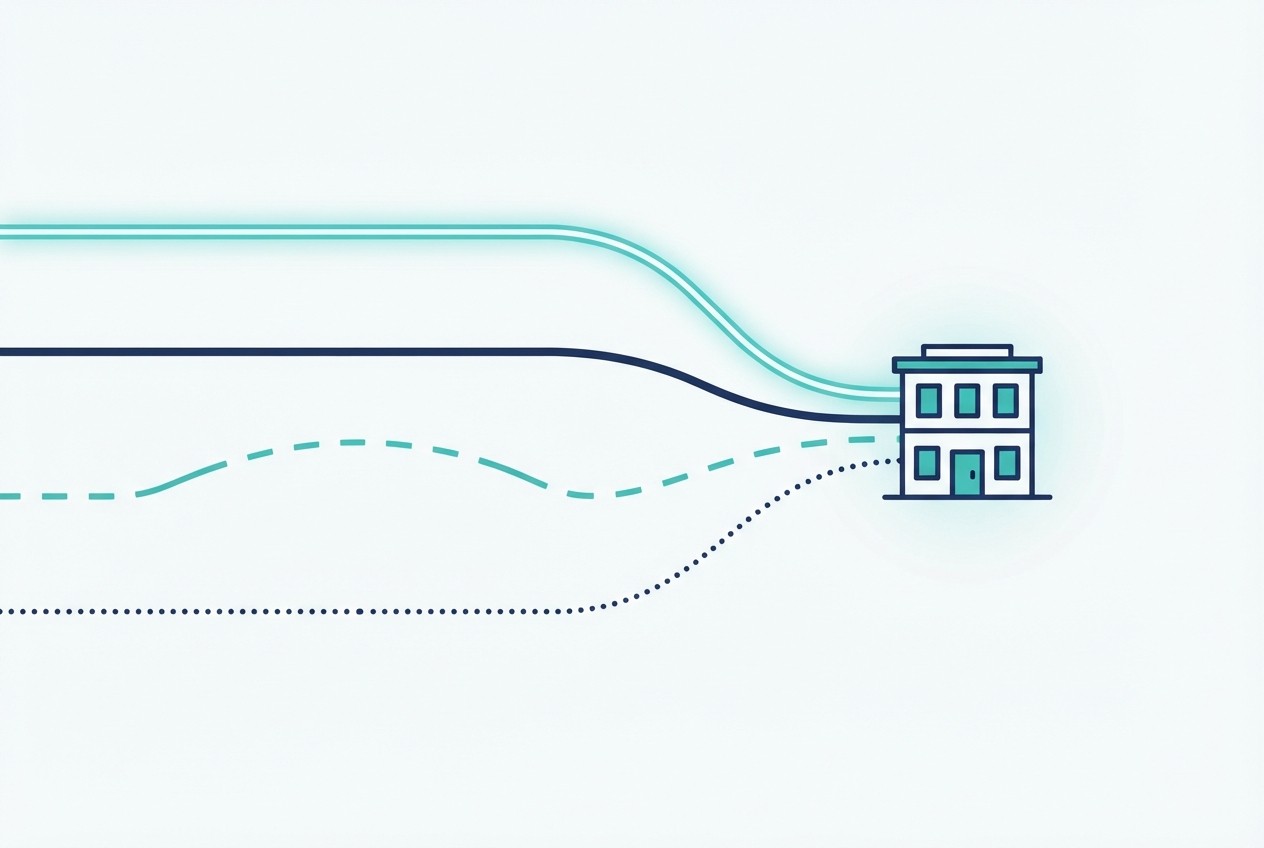
| Factor | Fiber | Cable | DSL | Fixed wireless |
|---|---|---|---|---|
| Speed ceiling | Highest | High download | Lowest | Moderate to high |
| Upload versus download | Often symmetrical | Upload much lower | Upload much lower | Varies |
| Latency | Lowest | Low to moderate | Moderate | Low to moderate |
| Shared with neighbours | Often not on business service | Yes, on the local segment | Line is yours; upstream shared | Yes, on the tower |
| Availability | Limited by physical reach | Widespread | Declining | Where line of sight exists |
| Installation lead time | Short if already at the building, long if construction is needed | Usually short | Short | Short |
| Typical failure | Cut cable, equipment fault | Neighbourhood congestion, node outage | Poor line, distance degradation | Obstruction, weather, interference |
Words in the offer that need translating
- “Up to.” Most consumer and many business plans advertise a maximum speed that is not a guarantee. Ask what speed is committed, if any, and what typically happens at busy times.
- Symmetrical. The same speed up and down. It matters if you upload a lot, which many offices do through video meetings, cloud backups and file sharing.
- Static IP address. A fixed public address, needed for hosting a service, some remote access arrangements and some security setups. Business plans often offer one, often at extra cost.
- Dedicated. Capacity reserved for you rather than shared. We cover the difference in our article on dedicated and shared internet.
- Business class. A label that can mean better support, better repair priority and static addresses, or nothing at all. Ask what the plan actually includes in writing.
Matching the connection to the office
- A small office with ordinary cloud use and a few video calls. Business-class cable or fiber, whichever is available, is usually adequate. Upload speed matters more than people expect.
- A shop or clinic with card payments and several staff devices. Reliability matters more than raw speed. Prioritise a provider with fast repair and consider a backup.
- An office that uploads large files, runs video all day, or hosts anything. Fiber, preferably symmetrical, with a service commitment.
- A rural or unusual location. Fixed wireless, or whichever wired option exists, with a cellular or satellite service as a backup.
- A temporary or pop-up site. Fixed wireless or cellular-based service can be set up quickly.
How to find out what is really available
- Check provider maps, but treat them as indicative. Coverage maps show where service might be available, not where it can be installed at your suite in your building.
- Ask neighbours and other tenants. Who serves the building, who has tried what, and how it has been. Their experience is more useful than a brochure.
- Ask your landlord. Building management may control access to the premises or have exclusive arrangements, and they know which providers have wiring in place.
- Request quotes from each provider that serves the address, including written statements of installation time, costs and what is delivered.
- Ask about construction charges. If new cable has to be built to reach you, ask for the amount and the timeline in writing before you agree to anything.
- Ask about the whole path. Is the connection to your door fiber all the way, or fiber to the street with a different technology the last stretch?
Questions for every provider
- What is the committed speed, up and down, as opposed to the advertised maximum?
- Is any part of the connection shared with other customers, and how do you manage congestion?
- What service level agreement applies, and what does it promise?
- What is your target time to repair, and what is your actual record?
- Is there a static address, and what does it cost?
- How long will installation take, and what could delay it?
- Is there a data cap or any throttling?
- What equipment is included, and who owns it?
- What happens when I move or close?
We do not quote prices, because they vary enormously by location and provider and are negotiable. We also cannot promise that any connection will deliver a particular speed or uptime. The provider’s published service terms are what you are buying, so read them.
Finally, choose with failure in mind. Every one of these connections will go down eventually. The question is how it fails, how quickly it is repaired, and what you will do in the meantime. We cover that in our guide to adding a backup connection, and it is worth deciding before you sign, not after the first outage.
What to do next
- Ask your landlord and neighbours which providers actually serve the building.
- Request written quotes from every provider covering committed speeds, installation time and any construction charge.
- Decide on a backup connection before the first outage, not after it.